Definition: Laplacian Matrix for triangle meshes

Definition of the Laplacian matrix and Laplace operator on a triangular mesh. This is a cheat sheet / summary, I give an in depth explanation here.
Laplacian matrix (triangle mesh)
Visually the matrix is symmetric and reflects the adjacency graph of our mesh, see a concrete illustration below and notice how vertex $0$ is connected to $\{1, 2, 3\}$; vertex $1$ to $\{0, 2, 3\}$ and so on:
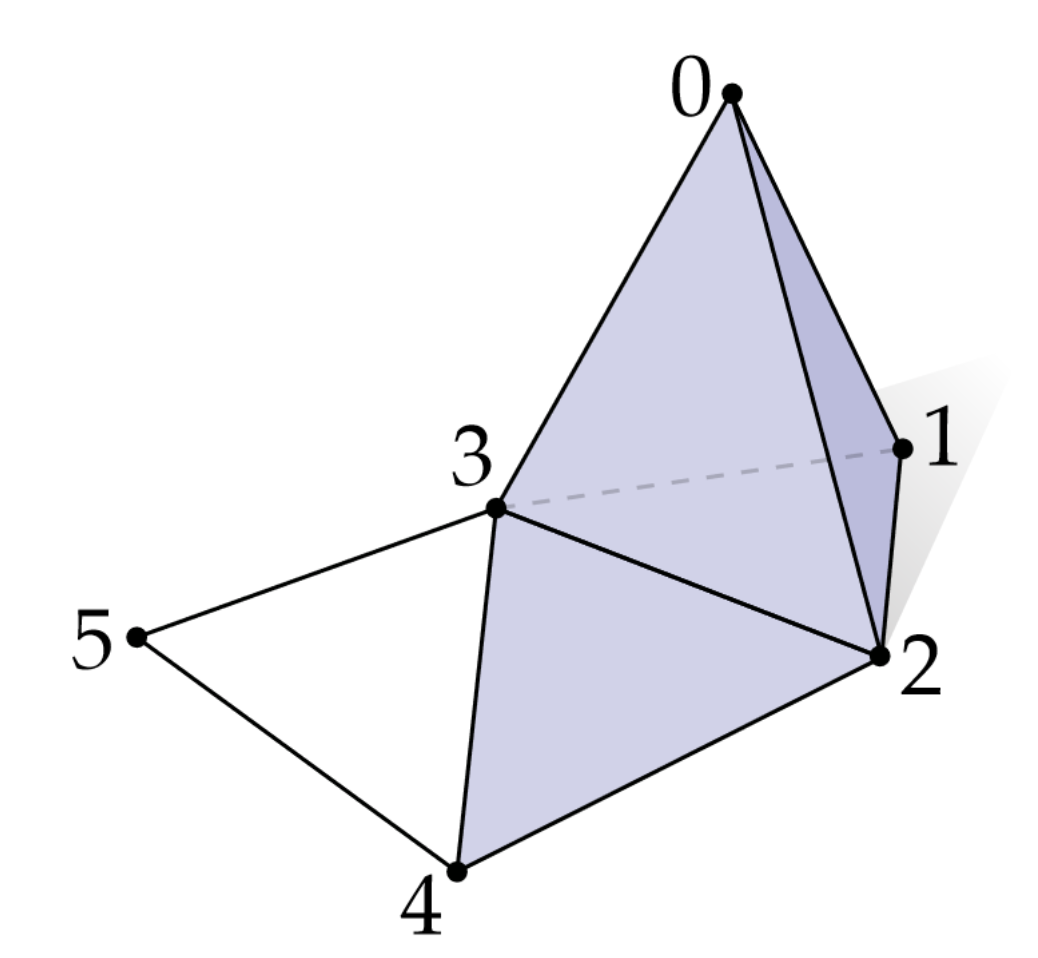
Formally, what is commonly called the Laplacian matrix $ \mathbf L $ in the literature of geometry processing is:
$$
\mathbf L_{ij} =
\left \{
\begin{matrix}
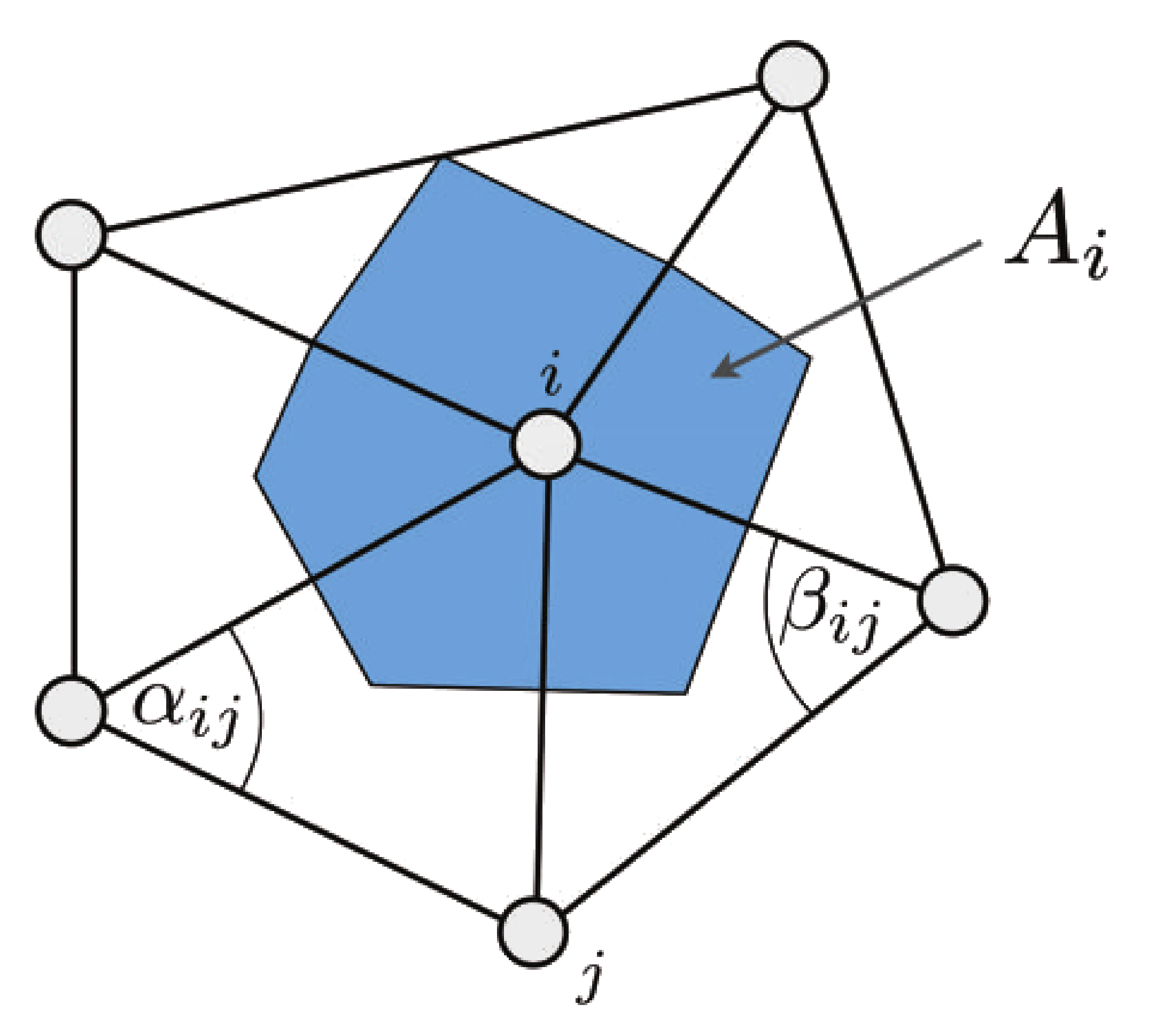
w_{ij} & = & \frac{1}{2} (\cot \alpha_{ij} + \cot \beta_{ij}) & \text{ if j adjacent to i} \\
& ~ & -\sum\limits_{{j \in \mathcal N(i)}} { w_{ij} } & \text{ when } j = i \\
& ~ & 0 &\text{ otherwise } \\
\end{matrix}
\right .
$$
- $ \mathbf L \in \mathbb R^{n \times n} $ with $ n $ the number of vertices of the mesh
- $ \mathbf L_{ij} $ is a single element of the matrix
- The row $ i $ and column $ j $ of the matrix represent vertex indices as well
- $ {j \in \mathcal N(i)} $ is the list of vertices directly adjacent to the vertex $ i $
- Each row of $ \mathbf L $ contains the list of vertices weights adjacent to $ i $
- $ \mathbf L $ is symmetric positive semi-definite
- $ \cot \alpha_{ij} $ and $ \cot \beta_{ij} $ is the evaluation of the cotangent function at $x= \alpha_{ij} $ and $y = \beta_{ij} $ (c.f. figure below)
$ \cot( \theta ) = \frac{\cos \theta}{\sin \theta} =\frac{\vec u . \vec v}{ \|\vec u \times \vec v\|} = \frac{\|\vec u\|.\|\vec v\| cos(\theta) }{\|\vec u\|.\|\vec v\| sin(\theta)} $
Remark: the general Laplacian matrix as defined in graph theory (as opposed to geometry processing like in here) is usually defined as $ -\mathbf L $
Discrete Laplace operator
On the other hand the Laplacian *operator* is defined as $ \mathbf {\Delta f} = {\mathbf M}^{-1} \mathbf L $ with the Mass matrix $ \mathbf M $, a diagonal matrix that stores the cell area (blue area on the figure) of each vertex:
$$
\mathbf M^{-1} =
\begin{bmatrix}
\frac{1}{A_0} & 0 & 0 \\
0 & \ddots & 0 \\
0 & 0 & \frac{1}{A_n}\\
\end{bmatrix}
$$
$$A_i = \frac{1}{3} \sum\limits_{{T_j \in \mathcal N(i)}} {area(T_j)}$$
- $ T_j \in \mathcal N(i) $ list of triangles adjacent to $ i $
- $ A_i $ can also be computed with mixed voronoi area.
Code
See the [  C++ code ]
to build the laplacian matrix with cotan weights (
C++ code ]
to build the laplacian matrix with cotan weights (get_laplacian() procedure)
If your mesh is represented with an half-edge data structure (each vertex knows its direct neighbours) the pseudo code to compute $ \mathbf L $ is:
// angle(i,j,t) -> angle at the vertex opposite to the edge (i,j)
for(int i : vertices) {
    for(int j : one_ring(i)) {
        sum = 0;
        for(int t : triangle_on_edge(i,j))
        {
            w = cot(angle(i,j,t));
            L(i,j) = w;
            sum += w;
        }
        L(i,i) = -sum;
    }
}
On the other hand the Laplacian $ \mathbf L $ may be built by summing together contributions for each triangle, this way only the list of triangles is needed:
for(triangle t : triangles)
{
    for(edge i,j : t)
    {
        w = cot(angle(i,j,t));
        L(i,j) += w;
        L(j,i) += w;
        L(i,i) -= w;
        L(j,j) -= w;
    }
}
 Donate
No comments